
History & Heritage
Hani and Sheh Mureed: A Promise That Became a Legend
Two childhood friends, a bowl of water and a promise that cost him everything. Meet Hani and Sheh Mureed, Balochi folklore’s great love story.
By Farnaz Fatimah · October 20, 2026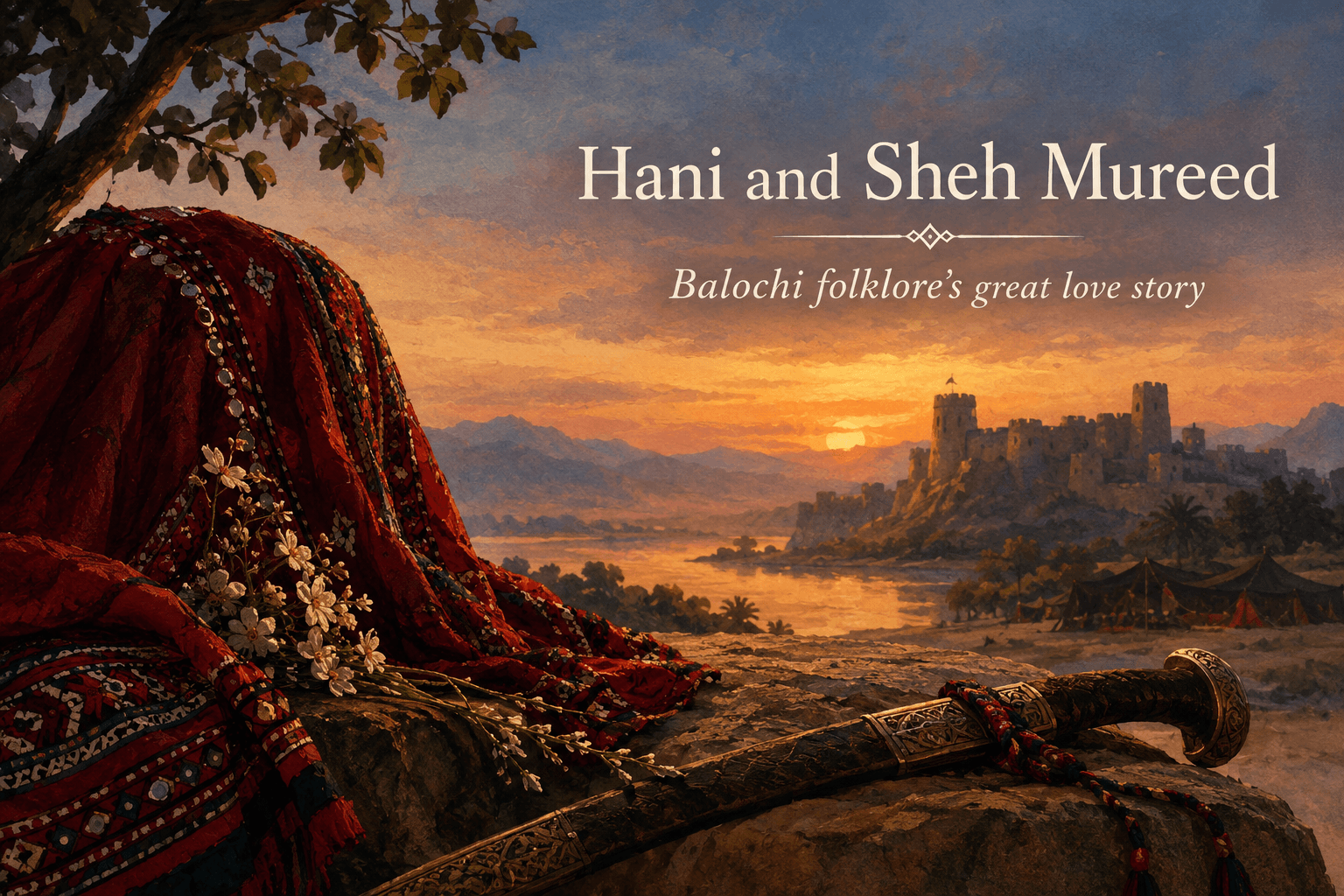
Every culture has one story it turns to when it wants to explain love. For the Baloch, that story is Hani and Sheh Mureed.
Minstrels have sung it for generations. Researchers have found about forty poems on it, in two main versions and several smaller ones, and no single poet can claim it. People often compare it to Layli and Majnun, but its heart is distinctly Balochi: a love tested not by distance or feuds, but by a promise.
What follows is the story as it is most often told. Like every oral tale, it changes a little from one teller to the next.
Two Friends Who Grew Up Together
In the 15th century, in a world of tribes, hunting parties and long feasts, there lived a young woman named Hani, the daughter of a Rind noble, and a young man named Sheh Mureed. They had been friends since childhood, and they were engaged. Their love was no secret. It had grown quietly, the way things do when two people have known each other all their lives.
A Bowl of Water
One day the great chief Mir Chakar Rind was returning from a hunt with Sheh Mureed. They stopped in the town where Hani lived, and she brought the guest a bowl of water.
It was a small gesture, but she did it with care. The bowl was silver, the water was clean, and floating in it she had placed a few well-washed pieces of dwarf palm leaf, so that a tired, thirsty rider would have to sip slowly. The story says Chakar realised how wisely she had acted. Before a single word was spoken between them, he had seen what kind of woman Hani was.
The Promise
Some time later, at a great feast, Chakar asked the nobles to make vows. When Sheh Mureed's turn came, he was thinking only of Hani and of his wedding day. He promised that on that day, if anyone asked him for something he owned, he would give it.
He expected a request for something ordinary. His bow, perhaps. It was famous, and he was a fine archer.
Chakar asked for Hani.
We can imagine how quiet the room became. Sheh Mureed was shocked, but he had given his word in front of everyone, and in that world a man's word was his honour. With a heavy heart, he told Chakar to take her.
The Wanderer
After that, Sheh Mureed's life was never the same. In many tellings he leaves ordinary life behind and becomes a wanderer, a man with nothing left but his devotion. Time passes. Then one day a beggar appears among the Rind, and the nobles begin to wonder who he is. Asked to draw a bow, he breaks one, then a second, then a third. Only one man had that strength. The suspicion in the hall turned to certainty: the beggar was Sheh Mureed.
How It Ends
Here the versions part ways. In one well-known telling, Chakar, seeing the loyalty of both Mureed and Hani, releases her and tells her she is free to go to the man who deserves her. In others the ending is sadder, and the lovers remain apart. Scholars point out that the tale carries love, heroism, dignity and a mystical strain, and that it begins with the heroic idea of keeping a promise.
What every version agrees on is what Sheh Mureed became. The Baloch remember him not only as a lover but as something close to a saint. A saying often repeated puts it simply: ta jahan ast, Sheh Mureed ast. As long as the world lasts, Sheh Mureed lives.
Why It Still Speaks to Us
This is not a story with a villain. Chakar is not cruel, Mureed is not weak, and Hani is not a bystander. Her wisdom is the first thing we learn about her. It is a story about what it costs to keep your word, and about a love that shows itself through restraint.
In a world of quick promises and loose words, a tale that treats a promise as sacred still has something to say. And because it belongs to Baloch everywhere, it is a story you can share with your children, wherever you live.
Share your story: which version did your grandmother or grandfather tell? Do you remember a song, a line of the poem, or a singer who performs it? Send it to us at baloch.net/contribute and we will preserve it.
Sources: Hani and Sheh Mureed (Wikipedia); Journal of Comparative Literature (Iran), comparison of Hani and Shaymorid with Layli and Majnun; Culture and Folk Literature (Iran), "The Structure of Motifs in the Story of Hani and Shaimorid."