
Story
Baloch in Oman: Muscat’s Second Homeland
Contributed by Farnaz · November 18, 2026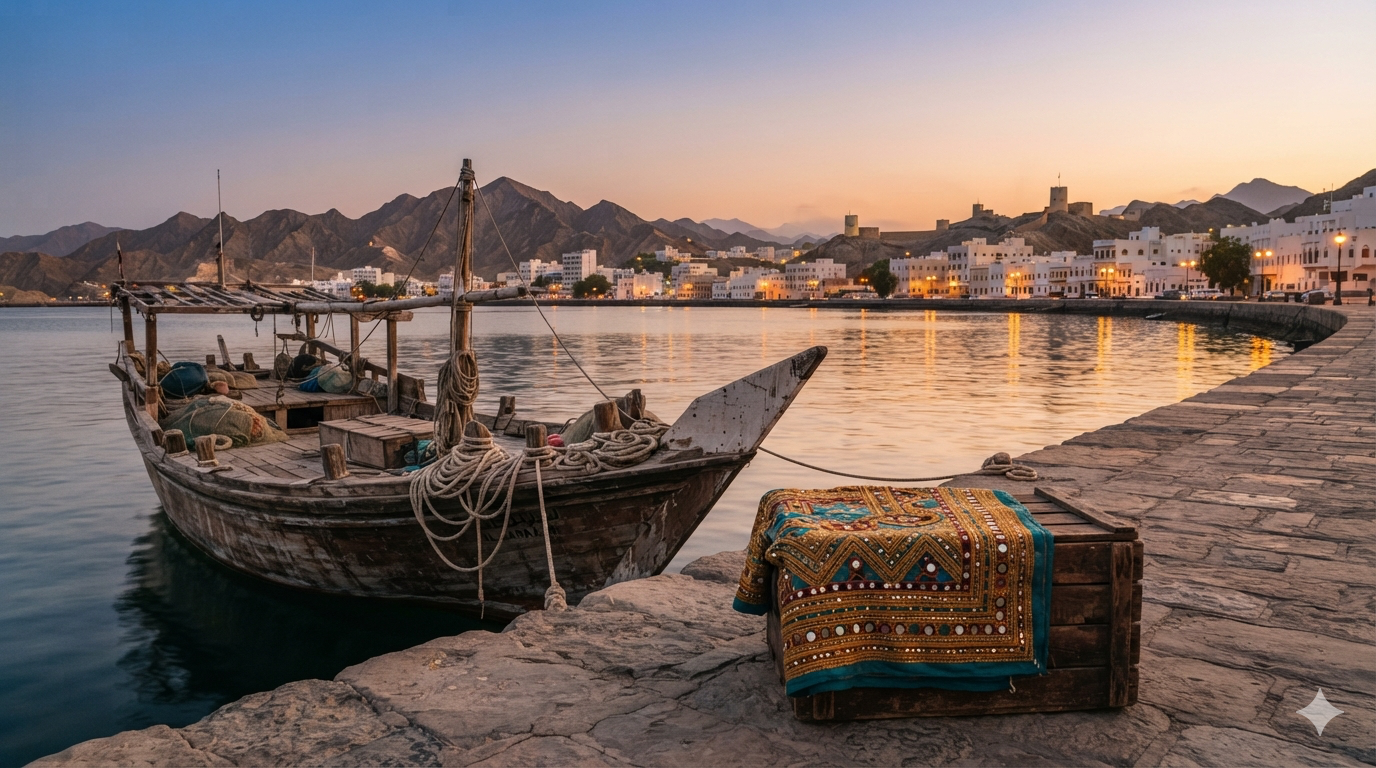
Stand on the Muscat waterfront and look north across the Gulf of Oman. On the far side lies Makran, the Balochistan coast. The sea between is narrow enough that for centuries families have made the crossing. Today in Muscat you can hear Balochi in homes and shops, see weddings full of drums and dance, and meet people whose surname is al-Balushi. Some estimates say that about one in five Omanis is of Baloch origin.
Across the Narrow Sea
Centuries of migration from Makran have created layers of Baloch community in Oman. Oman was once a seafaring empire whose reach stretched from Zanzibar to Gwadar, and Baloch people were part of that world as soldiers, traders and settlers. The historian J.E. Peterson writes that the first modern organised army unit in Oman, the Muscat Levy Corps, was entirely Baloch. In Mombasa, Baloch soldiers were given land and settled near the Old Town. The ties ran in many directions.
Today Baloch Omanis are well known in the army and the police, but that is only part of the picture. They are also teachers, artists, IT specialists, skilled technicians and business owners.
A Home in a Pluralistic Nation
Oman stands out in the Gulf for openly acknowledging its diversity. A UCLA ethnomusicology study describes Arabs, Swahili-speaking Zanzibaris and Baloch as the largest groups in a unified but explicitly pluralistic national identity. It goes as far as calling Muscat a major capital of Baloch culture, home to the largest concentration of Baloch outside Balochistan and Karachi.
Mashkat: Balochi With an Omani Accent
In Balochi, Muscat is called Mashkat, and the community there has its own character. Researchers describe a local variety of Balochi shaped by the Arabic spoken in Muscat. Older families come mainly from the Iranian side of Makran, while newer arrivals come mostly from the Pakistani side and speak with a hint of Urdu. Baloch families live across the city, in neighbourhoods such as Jibroo, Matrah, Khoudh, Maabila and Wadi Hattat. Muscat also has a lively community of Baloch writers and poets, in literary forums that link the Gulf with Karachi, Balochistan and even Scandinavia.
Where Weddings Become Festivals
If you want to hear Mashkat's Baloch culture, go to a wedding. Young Baloch wedding bands now combine electric guitars and keyboards with big drum sections, and their songs can run for twenty minutes, built on call-and-response chants and a relentless beat. Women gather separately for henna parties, where women dance together to the band's music. Older traditions continue too, such as the circle dance called lewa, which people in Muscat and Karachi connect with both Makrani Baloch and wider African heritage, and wedding dances in the Batinah region.
The musical ties to home are strong. One Muscat musician told the researcher that in the early 1970s he travelled to Karachi, bought a benju from a famous Makrani maker, and became a wedding musician. Karachi's Lyari district, with its own music scene, still influences what Muscat bands play. If you have read our story of Ustad Noor Bakhsh, you will recognise the instrument.
At Ease Everywhere
Baloch Omanis are often described as unusually adaptable. They are active in the Oud Hobbyists' Association, the Royal Oman Symphony Orchestra, and the cover bands that play in Muscat's hotels. A once-legendary Baloch group, Los Balochos, built its sound on the Gypsy Kings. And one well-known Muscat Baloch singer made a comic song greeting listeners in half a dozen languages, from Arabic and Balochi to Hindi, Swahili and Thai. It is a small joke that says a lot: here is a community that belongs to the whole world and to its own culture at once.
Why It Matters
For Baloch readers far from Makran, Oman is a reminder that a people can keep its language, music and family ties across a sea, and still be fully part of the place where it lives. For Omani readers, it is a chance to see a part of their own country's history through Baloch eyes.
Share your story: do you have family in Oman, or memories of Matrah, Jibroo or a Muscat wedding? Send your photos, songs and stories to us at baloch.net/contribute and we will preserve them.
Sources: George Murer, "The Forging of Musical Festivity in Baloch Muscat," Ethnomusicology Review, UCLA; Omani Baloch (Wikipedia); Sindh Courier, on Baloch in Oman and J.E. Peterson; Muscat: Where the Arab World Meets the Indian Ocean (Ajam Media Collective).