Language & Literature
Balochi, Kurdish and Persian: Linguistic Connections and Historical Questions
Balochi, Kurdish and Persian belong to the Iranian language family, but their historical classifications and development are not identical. Explore their linguistic connections, patterns of contact, historical theories and the limits of what language can tell us about shared origins.
By Baloch.Net Editorial Team · November 26, 2026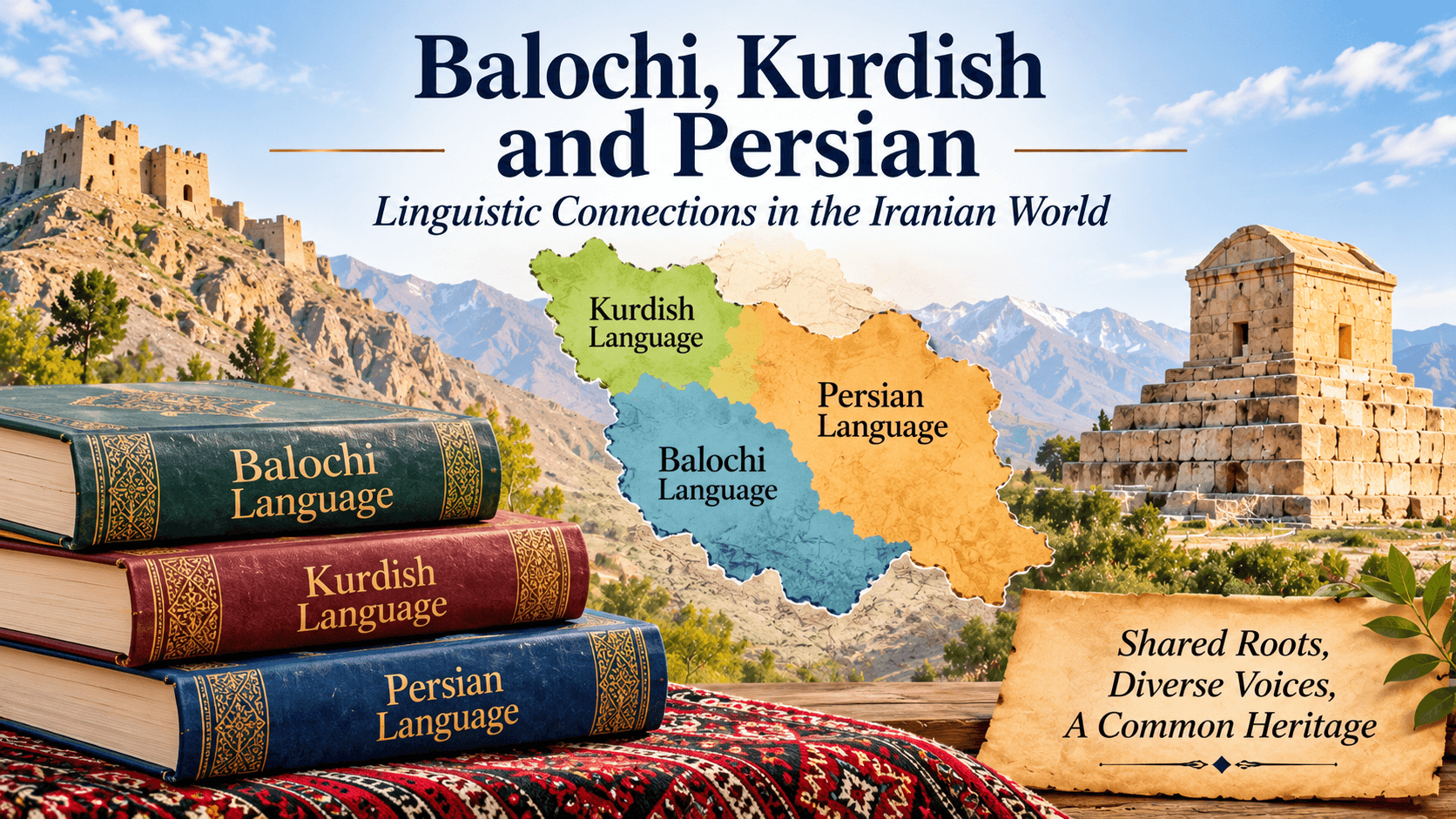
Introduction
Balochi, Kurdish and Persian belong to the Iranian branch of the Indo-Iranian language family. Their relationships are important to understanding the linguistic history of the Iranian world, from western Iran to Balochistan. These languages share historical connections, but they do not all belong to the same immediate linguistic subgroup.
Balochi is conventionally described as a Western Iranian language and has often been classified among the Northwestern Iranian languages. Kurdish is also generally classified as Northwestern Iranian, while Persian is conventionally placed in the Southwestern Iranian group. These labels describe linguistic classifications, not ethnic identities or tribal genealogies. The detailed subgrouping of Iranian languages remains a subject of scholarly discussion.
Balochi and Kurdish
Josef Elfenbein describes Balochi as, in essential respects, a Northwestern Iranian language closely related to Parthian and modern Kurdish, Tati and Taleshi, while also noting important features that distinguish Balochi from other modern Western Iranian languages. Carina Jahani likewise discusses the traditional Northwestern Iranian classification of Balochi and its close relationship with Kurdish, despite the language being spoken in the southeast of the Iranian linguistic area.
Comparative evidence includes historical sound correspondences and grammatical structures. Such evidence can establish linguistic relationships and shared developments, but it does not identify a single ancestral tribe or prove that Baloch and Kurdish communities descend from one recent common population.
Balochi and Persian
Persian is conventionally classified as Southwestern Iranian, whereas Balochi is traditionally placed among the Northwestern Iranian languages. Both are Western Iranian languages, and their histories have involved contact as well as inherited similarities.
Similar vocabulary or grammatical features should therefore be examined individually. A feature may be inherited from an earlier Iranian language, borrowed through contact, or shaped by wider areal developments. Chundra A. Cathcart argues that patterns of West Iranian sound change cannot always be explained by assuming that irregular forms in non-Persian languages were simply borrowed from Persian. Persian may not have been the only donor, and borrowing is not always the mechanism responsible for an unusual form.
Evidence of contact between Balochi and Kurdish
Shuan Osman Karim examines similarities between the Balochi imperfective marker a- and the corresponding marker in Central Kurdish, as well as similarities in how these forms attach to particular verbs and in certain past constructions. Karim argues that the constructions ultimately have different etymologies, while their convergence is unlikely to be accidental.
This research is a useful example of why linguistic comparison requires more than matching words or forms. Similarity can arise through contact and convergence even where the forms do not descend from the same original construction.
Historical movement and Balochi origins
Elfenbein reports H. W. Bailey’s suggestion that, if the name Baloch is Iranian, it may represent the Old Iranian term *ṷadraṷatī, associated with Gedrosia and the land of underground water channels. This proposal could explain why the people are not known by the name Baloch before their arrival in southeastern Iran from the central Caspian region more than a thousand years ago. Elfenbein cautions that identifying them with tribes mentioned in earlier classical sources is necessarily difficult.
This is a historical interpretation, not a universally established migration account. Linguistic classification alone cannot prove a particular migration route, identify an ancestral tribe, or establish a direct historical connection between Baloch and Kurdish communities. Such questions require independent historical, archaeological, textual and community evidence.
An Iraqi Kurdish oral account
An oral account reported to Baloch.net describes Baloch and Kurds as “parted brothers”. The expression is worth recording as an account of how a relationship between the communities is remembered or understood by some people. It is oral testimony, not independently verified historical evidence.
The specific account still requires fuller documentation, including the community and locality in which it is told, the people who transmit it, its original wording and the context in which it is used. It should not be treated as proof of shared genealogy, a common tribe or a particular migration.
What linguistic evidence can and cannot establish
- Balochi, Kurdish and Persian are related languages within the Iranian branch of Indo-Iranian.
- Balochi and Kurdish share important Northwestern Iranian characteristics in conventional classifications.
- Persian is conventionally classified as Southwestern Iranian, while also sharing a wider Western Iranian history and extensive contact with other Iranian languages.
- Some similarities between Balochi and Kurdish grammatical constructions may reflect contact and convergence rather than identical origins.
- Linguistic relationships do not, by themselves, establish common tribal descent, a shared recent ancestor or a single ethnic identity.
Conclusion
The relationship between Balochi, Kurdish and Persian is best studied through comparative Iranian linguistics, historical sound change, grammatical development and language contact. These connections illuminate the shared linguistic history of the Iranian world, while reminding us to distinguish language history from ethnic identity, oral tradition and genealogy. Each requires its own evidence and careful interpretation.
Sources & References
- Josef Elfenbein, Baluchistan iii. Baluchi Language and Literature, Encyclopaedia Iranica (1988; updated 2016) — Elfenbein, Josef. Baluchistan iii. Baluchi Language and Literature. Encyclopaedia Iranica, vol. III, fasc. 6, pp. 633–644. Published 15 December 1988; last updated 25 October 2016.
- Carina Jahani, The Balochi Language and Languages in Iranian Balochistan (2013) — Jahani, Carina. The Balochi Language and Languages in Iranian Balochistan. Journal of the Middle East and Africa 4 (2013), pp. 153–167. https://doi.org/10.1080/21520844.2013.831333.
- Chundra A. Cathcart, Dialectal Layers in West Iranian (2022) — Cathcart, Chundra A. Dialectal Layers in West Iranian: A Hierarchical Dirichlet Process Approach to Linguistic Relationships. Transactions of the Philological Society (2022). First published 19 March 2022. https://doi.org/10.1111/1467-968X.12225.
- Shuan Osman Karim, Contact Across the Iranian World: Curious Convergences between Kurdish and Balochi (2026) — Karim, Shuan Osman. Contact Across the Iranian World: Curious Convergences between Kurdish and Balochi. Journal of Iranian Linguistics 2, no. 2 (2026), pp. 6–41. Issue labelled 2025; published 17 April 2026. https://doi.org/10.46991/jil/2025.02.01.
Balochi languageKurdish languagePersian languageIranian languages